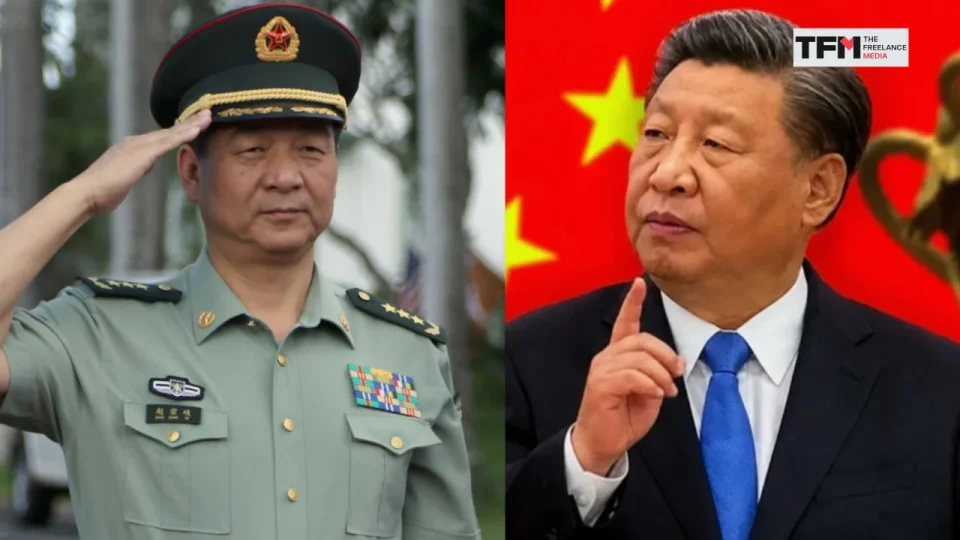
Courtesy: X
China has stripped General Zhao Zongqi, the former commander of the People’s Liberation Army Western Theatre Command, of his remaining political posts. Zhao headed that command during the 2017 Doklam standoff and the 2020 Galwan Valley clash with India.
The Standing Committee of the 14th National Committee of the Chinese People’s Political Consultative Conference voted on 26 August to remove him from the standing committee, dismiss him as deputy director of its ethnic and religious affairs committee, and revoke his CPPCC membership. State-run Xinhua and the People’s Daily published the decision. They gave no reason and did not say whether he faces an investigation, according to Reuters and India Today.
The Western Theatre Command controls PLA operations across Tibet and Xinjiang and along much of the border with India. Zhao became its first commander in February 2016 after the PLA’s theatre reforms. He retired from the post in December 2020 after reaching the usual age limit and was later given advisory roles.
Why does Zhao’s name still matter in India?
He was in charge when Chinese troops tried to extend a road at Doklam, near the India-China-Bhutan trijunction, in June 2017. Indian soldiers intervened. The face-off lasted 72 days before both sides disengaged.
He was still in command when the eastern Ladakh standoff began in May 2020. On 15 June that year, troops fought with stones, rods and improvised weapons in the Galwan Valley. Twenty Indian soldiers were killed. China officially acknowledged four PLA deaths. Later reporting and investigations pointed to a higher Chinese toll. India Today cited estimates of at least 38 Chinese soldiers dead.
ANI reported in 2020, citing a US intelligence assessment first described by US News & World Report, that Zhao had authorised the Galwan operation to “teach India a lesson”. That claim came from an anonymous source familiar with the assessment. Beijing has never confirmed it.
India Today’s then China correspondent Ananth Krishnan wrote in 2017 that Zhao was considered responsible for China’s handling of Doklam. After that crisis he stayed on the Communist Party Central Committee. The quiet removal six years after he left the Western Theatre is a late political reversal, not a battlefield one.
Is this just one general, or a wider PLA shake-up?
It sits inside a larger clean-out. On 28 August China removed Zhang Youxia and Liu Zhenli from the state Central Military Commission after investigations into suspected “serious violations of discipline and law”, Reuters reported, citing Xinhua.
Zhang was vice-chairman of the CMC and a Politburo member, second only to Xi Jinping in the uniformed chain. Liu was a CMC member and chief of staff of the Joint Staff Department. Their removal leaves two active members on a body that once had seven, including Xi himself.
A February 2026 assessment by the Center for Strategic and International Studies found that 101 senior PLA officers had been dismissed or had disappeared, affecting about 52 per cent of China’s military leadership positions. Xi told senior Communist Party leaders in July to intensify the fight against corruption in the armed forces.
Zhao’s case is different in one respect. Beijing has not publicly tied him to a discipline probe. The announcement is a vote in the advisory body, not a CMC indictment. Speculation that he is the latest purge target remains just that until an official charge appears.
What should readers not treat as confirmed?
Posts on X on Saturday recycled the India Today headline and framed Zhao as “the general who faced India”. Some users claimed secret detention by China’s Ministry of State Security. No official source has confirmed detention. That claim should not be treated as fact.
The Tribune and some Indian outlets described him as stripped of Communist Party membership. The Xinhua-based accounts and Reuters describe the loss of CPPCC posts and membership. Those are not the same thing.
Beijing has offered no comment on what the move means for the Line of Actual Control or for talks with India. Zhao left the Western Theatre more than five years ago. The command itself continues under later successors.
The documented facts are narrower. A general who ran China’s India-facing theatre through two of the most serious recent border crises has now lost his last listed political titles. The party has not said why.