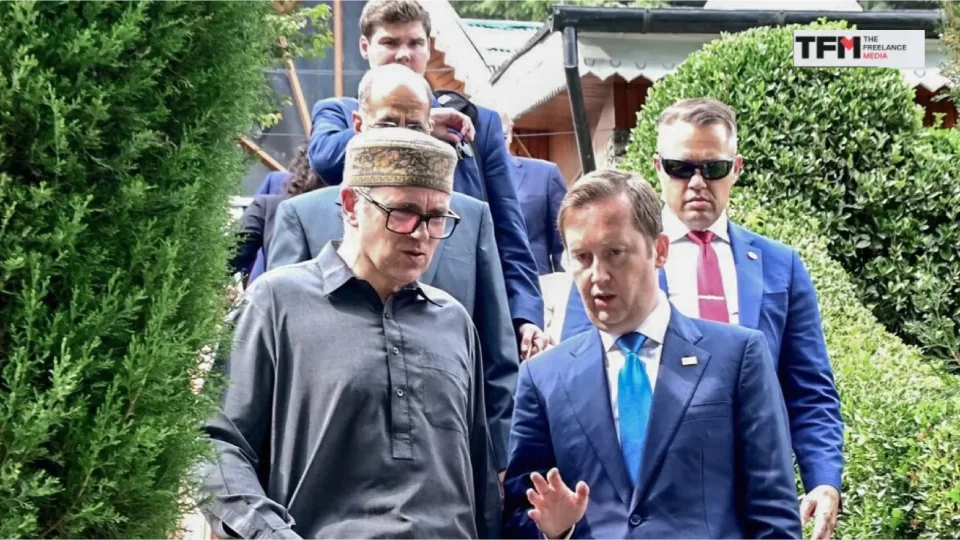
Sergio Gor’s comment in Kashmir that ‘Kashmir is an important part of India’ need not make us euphoric, even though Pakistan’s disappointment can well be understood.
Perhaps, a large number of Indians are not aware of the fact that America was well disposed towards India’s freedom movement in early forties and kept prodding Churchill on many occasions to grant freedom to India. However, it was Churchill, an undisputed leader of Allies in their fight against Nazis during that period, and their window to Indian subcontinent, that the American President eventually went by what Britain decided.
However, as the sun set on British Empire at the end of WWII and America, with its vast resources, extensive military-industrial complex and ability to project power much beyond its own shores, emerged as the leader of the free world. Its confrontation with the Soviet Union, immediately thereafter, defined the American politico-mil strategic posturing in the world, including in South Asia.
From Wavell to Auchinleck and Olaf Caroe to Linlithgow all British strategists had foreseen the possibilities of Congress under Nehru tilting towards Soviet Union after India became free. As a matter of fact, such likelihood of strategic shift post-British withdrawal from south Asia, had unnerved the allies to such an extent that they embraced Jinnah to ensure vivisection of India. Jinnah had categorically assured Britain that he would be a part of their alliance to protect their interests in South Asia, post-partition. No wonder Pakistan became part of almost every military alliance that the U.S. created against the Soviet Union in the decades following the creation of Pakistan.
Ever since, Pakistan has always enjoyed American support in all its confrontations with India, right till the latest one during Op Sindoor. This support has not just been confined to wars but also through diplomacy at various fora, be it U.N. or elsewhere.
Right from Kashmir’s accession to India, America continued to play a spoiler right to the present day. Initially, it was Loy Henderson, wife of the U.S. Ambassador to the U.N. and a CIA agent who encouraged Sheikh Abdullah on his path to seek independence for J&K. Later it was Adlai Stevenson, Eisenhower’s Democratic opponent in the presidential election (later American Ambassador to the U.N.) who encouraged Sheikh Abdullah to consider creating an independent state. This process continued when Sheikh Abdullah was contacted by Mr Austin at Lake Success, during Sheikh Abdullah’s visit to New York as part of Indian delegation to the U.N.
The American stated policy till late has been that J&K is a ‘disputed territory’. Therefore, Sergio Gor’s comment appears to be not in keeping with the long-held American policy. No wonder Pakistan’s heckles were raised and it had to issue a demarche to the U.S. Ambassador to Pakistan.
In view of the long-held American policy in south Asia, it will be naïve to think that Gor’s one-off statement reflects a decisive shift in the American policy in our region. After all, in Trump Presidency, long-existing relationships with its own iron-clad strategic partners have been weakened (even destroyed) for short term gains. The World has been witnessing the unpredictable nature of the POTUS whose statements given in the morning become redundant in the afternoon when he issues a completely contrasting statement, even before the media had broadcast/telecast the first statement to the world, thus creating a huge confusion among the policy planners.
Let us also not forget that Trump has whole-heartedly supported the Mecca Joint Defence Agreement which, leaving the rhetoric aside, is an obvious threat to Israel, a steadfast ally of America, besides being a clear threat to India, which is not even an American ally. MJDA is not a Muslim NATO, but a beginning of the effort to create a new Khilafat whose abolition by Britain at the end of WWI, has continued to be resented by the Um’ah – particularly by those among the Muslim world, who have now formed this alliance.
Therefore, India has to take Sergio Gor’s statement with a pinch of salt. Let us wait and keep a close watch on the American policy changes. After all taste of the pudding lies in eating.
Colonel Tej Kumar Tikoo (Retd.), PhD, is a highly respected Indian Army veteran, author, and prominent defence analyst. He regularly appears as an expert on national media platforms to comment on geopolitics, terrorism, national security, and international conflicts