Courtesy: X//War_crazy44
The History of PoJK and the 1947-48 Raider Attack
Pakistan-Occupied Jammu and Kashmir, referred to by Pakistan as "Azad Kashmir" and "Gilgit-Baltistan", comprises about 42% of the former princely state of Jammu and Kashmir.
When British India was partitioned in August 1947, J&K was a princely state under Maharaja Hari Singh. The Maharaja initially sought to remain independent. In October 1947, within weeks of Partition, armed tribal raiders backed, armed and guided by the Pakistan Army and government, invaded J&K from the northwest. Their stated goal was to force the Maharaja to accede to Pakistan.
The raiders advanced rapidly toward Srinagar, looting, killing and committing mass atrocities in Baramulla and other towns. Facing collapse, Maharaja Hari Singh signed the Instrument of Accession to India on 26 October 1947. Indian troops were airlifted to defend Srinagar.
The war continued until December 1948. A UN-mediated ceasefire took effect on 01 January 1949, leaving a Ceasefire Line later named as Line of Control after Shimla Agreement. The territory west and north of the ceasefire line remained under Pakistani control and became what is today PoJK and Gilgit-Baltistan. India regards the entire state, including PoJK, as an integral part of India, while Pakistan administers it as a disputed territory.
Since then, PoJK has not had the same constitutional status as Pakistan’s four provinces. It is governed through the "Azad Jammu and Kashmir Interim Constitution Act", with real power resting with Islamabad and the Pakistan Army.
Why is Pakistan in Turmoil and Facing Civil War-like Conditions?
Pakistan in 2026 is grappling with a multi-dimensional crisis that has pushed several regions to the brink:
1. Political Instability :Civilian governments have been weak and short-lived. The military remains the final arbiter of power. The recent shift of nuclear command to the National Strategic Command under a 4-star General formalises what was already de facto military control. Opposition crackdowns, jailing of leaders, and engineered elections have eroded legitimacy.
2. Economic Crisis : Inflation, debt defaults, IMF conditions, and energy shortages have devastated the middle and poor classes. Pakistan treats resource-rich peripheries like Balochistan and PoJK as "colonies" to extract hydropower, minerals and taxes, while returning little investment. Promised subsidies on wheat flour and electricity are routinely rolled back citing "budget shortages" and financial constraints.
3. Terrorism and Insurgency : Militancy has surged. Baloch separatists, TTP in Khyber Pakhtunkhwa, and sectarian groups operate with impunity. The Army’s policy of using some proxies while fighting others has backfired.
4. Provincial Alienation : Balochistan, Sindh, Khyber Pakhtunkhwa and PoJK all have movements accusing the Punjab-dominated establishment of exploitation. This fuels narratives of "Pakistan slipping into civil war and ultimately breaking into four ie Punjab, Sindh, Balochistan, and Pakhtunkhwa.
The combination of a bankrupt economy, no political outlet, and a security state has created conditions for prolonged unrest, though a full national civil war is still contained by the Army’s centralised and authoritative force.
Who is JAAC? What are its Demands and Why Was it Banned?
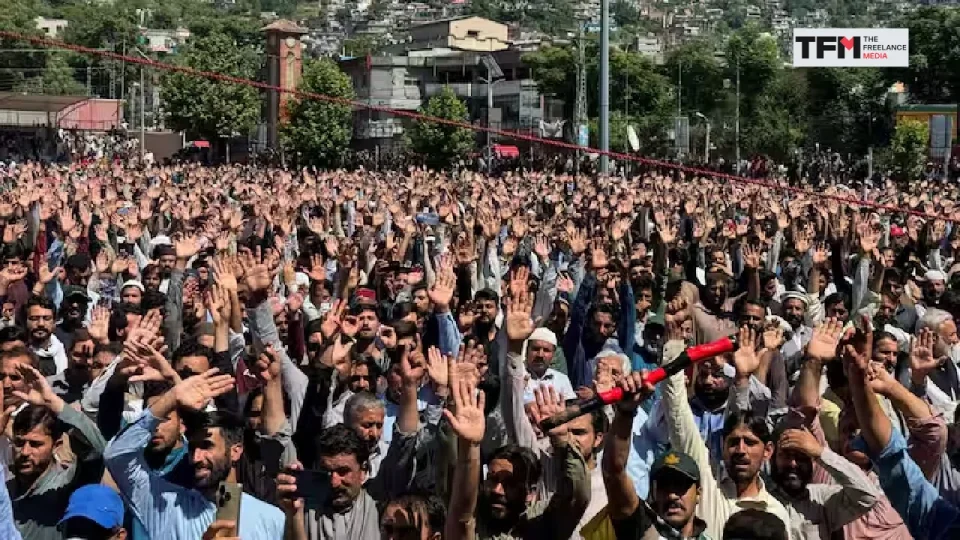
The Joint Awami Action Committee (JAAC)emerged in PoJK in 2023-2024 as a broad coalition of traders, students, lawyers, and local political groups. It became the main voice of public anger after the 2025 wheat and electricity price hikes triggered massive protests.
Core 38-Point Demands of JAAC:
1. Political Rights :Abolition of 12 "Refugee Seats" in the PoJK Assembly reserved for Pakistan-based refugees, who are used to rig elections and assist in installing puppet government in Muzzafrabad . Therefore , there is strong demand that only PoJK residents vote and govern.
2. Economic Justice : Electricity tariffs based on local hydropower generation cost, not imported rates. Heavily subsidised wheat flour. End to siphoning of PoJK’s water resources like Mangla Dam without compensation. Stop diverting Neelam River Water which is main source of water of POJK to Punjab.
3. End Elite Privileges :Cut luxury allowances and housing quotas for non-local Pakistani bureaucrats posted in Muzaffarabad.
4. Civil Liberties : Release of more than 1000 detained activists, removal of "terrorist" designation from JAAC, and restoration of internet and mobile services.
Why Banned JAAC?
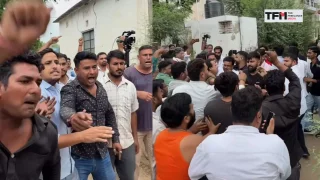
After the late-2025 protests paralysed Muzaffarabad, Islamabad responded with force instead of negotiation. Using anti-terrorism laws, the federal government proscribed JAAC, arrested leaders, and shut internet. The establishment views JAAC not just as an economic protest group but as a political threat challenging the Army’s control over PoJK’s resources and electoral process. Banning it allows use of Rangers and Army for crackdowns with legal cover.
Are Elections in PoJK Fair and Inclusive?
The evidence from the 27 July 2026 first phase suggests elections have been systematically rigged.
- Boycott Appeal: JAAC called a total boycott. In Kotli , Bhimber and Mirpur, visuals showed empty polling stations.
- Limited Voting :Voting only occurred in select Mirpur constituencies under about 20,000 security personnel. Rawalakot and Sudhnoti polling was postponed to 10 August due to massive protest in Rawalakot .
- Structural Rigging :The 12 "Refugee Seats" mean about 10% of the Assembly is decided by voters who do not live in PoJK. Mainstream parties in Islamabad control these seats.
- “Sham" Allegations :Local PTI units and independent observers allege ballot stuffing and pre-filled boxes.
Thus, the elections lack legitimacy locally. They are conducted to provide a veneer of democracy while ensuring Islamabad and Rawalpindi retain control.
📍 PoJk 29-08-2026
— Wingsblue🇮🇳 (@War_crazy44) August 29, 2026
PoJk Today pic.twitter.com/OEl6AF8thH
Why is the International Community "Quiet" on Pak Army Atrocities?
International silence is not total, but it is muted. Reasons include:
1. Geopolitics :The US and West need Pakistan for Afghanistan-related counterterrorism and to manage Iran. China is Pakistan’s "all-weather ally" and blocks criticism at the UN.
2. Nuclear Factor : Pakistan’s nuclear weapons make outside powers cautious about pushing too hard and risking state collapse.
3. Competing Crises :Gaza, Ukraine, and the US-Iran standoff dominate diplomatic bandwidth in 2026.
4. Access :Pakistan restricts media and NGOs in PoJK. UN Human Rights Commissioner Volker Turk has condemned the use of anti-terror laws against civilians, but without enforcement mechanisms.
However, with more than 80 fatalities reported since June 2026, scrutiny is slowly mounting in European parliaments and human rights NGOs.
What is the Likely Future of PoJK? Will There Be Civil War and Will PoJK Join India?
Predicting the future requires separating wishes from realities.
Scenario 1: Continued Crackdown and Status Quo
Most likely in the short term. Pakistan will use Army and Rangers to suppress JAAC, hold controlled elections, and continue resource extraction. Economic pain will persist, leading to cyclical protests.
Scenario 2: Escalation to Civil Conflict in PoJK
If the blockade continues and JAAC’s march from Rawalakot to Muzaffarabad grows, localised clashes with security forces could intensify. Local leaders have already warned they may "look across the LoC to India for survival" if Islamabad abandons them. This does not mean accession, but it signals total loss of legitimacy for Pakistan.
Scenario 3: Pakistan Fragmenting
The "Pakistan breaking into four" thesis is popular on social media . The Army is still cohesive. However, prolonged political instability , economic crisis , terrorism increaseing manifold and PoJK unrest could stretch the state beyond imagination. A national civil war is possible but not inevitable. More likely is chronic low-intensity conflict in peripheries and terrorist groups becoming more active.
Scenario 4: PoJK Joining India
For PoJK to join India, three things would be needed:
1. Collapse of Pakistani state authority in the region.
2. Overwhelming local demand expressed freely.
3. A major India-Pakistan Clash or negotiated settlement.
Currently, there is anger against Pakistan, but also fear of war. India’s official position remains that PoJK is part of India, but India has not signaled military action. Any change would depend on internal dynamics inside PoJK and Pakistan’s stability. However, there are also some voices coming from PoJK to join India due to economic reasons.
Conclusion
PoJK’s story since 1947 is one of broken promises. Invaded as a "liberation", it became an administrative periphery. Today, JAAC’s boycott and protests reflect a population tired of being treated as a resource colony.
Pakistan’s broader political and economic crisis means the establishment has even less room to offer concessions. This guarantees more turmoil.
Whether this leads to civil war, fragmentation, or a change in PoJK’s status depends on two variables: how far Islamabad is willing to use force, and how far the people of PoJK are willing to resist.
The international community will likely remain cautious until the cost of silence exceeds the cost of intervention. For now, PoJK remains the most volatile and least reported crisis in South Asia, and its trajectory will shape the security of the entire region.