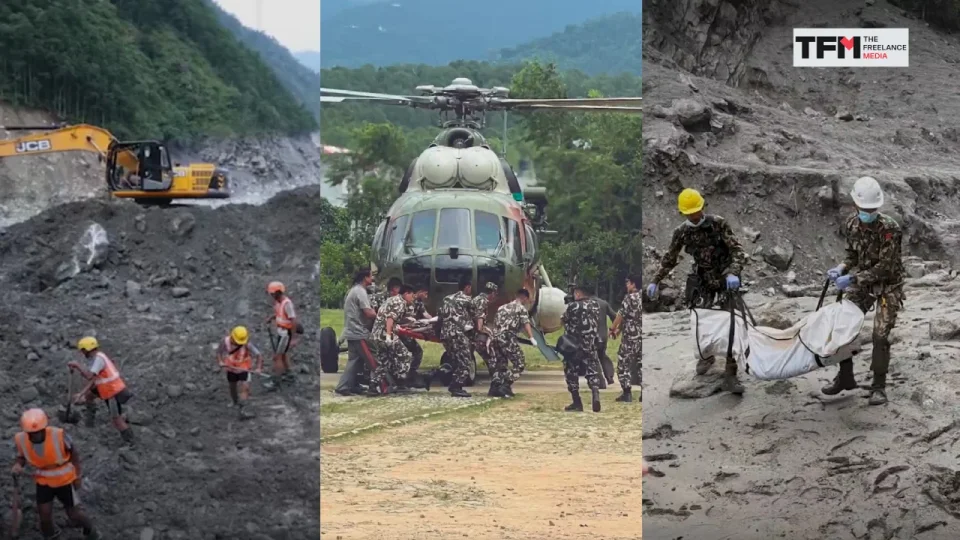
Courtesy: X/NepaliArmyHQ
Nepal Flood News: Nepal is burying unidentified victims of the 26 August flash floods after mortuaries ran out of space. The work is not meant as a final funeral. Officials say each body is tagged, sampled and mapped so a family can later match DNA and take the remains for last rites.
The flood began as a glacial collapse near the Nepal–Tibet border and tore through the Bhote Koshi and Trishuli rivers. Bodies have been pulled from Rasuwa, Nuwakot, Dhading, Chitwan and districts far downstream. Some remains have been reported in India. Counts still move by the hour. Media Reports cited about 734 recovered in Nepal by 30 August. The Straits Times later put Nepal’s death toll at 752, with 2,502 missing, including 589 foreigners. China has reported 16 dead and hundreds missing in Tibet. India Today, citing The Kathmandu Post, said only 20 of 768 recovered bodies had been identified by Saturday evening.
जबसम्म अन्तिम नागरिक सुरक्षित स्थानमा पुग्दैनन् तबसम्म हामी एक कदम पछि हट्दैनौँ #NepaliArmy....
— Nepali Army (@NepaliArmyHQ) August 30, 2026
बाढी प्रभावित क्षेत्रहरूमा राहत वितरण, खोज तथा उद्धारमा #नेपालीसेना....#BhoteKoshiFlood pic.twitter.com/8jN3yDP2dx
Why are the dead going into the ground first?
Hindu-majority Nepal usually cremates. Officials say they cannot do that while so many remains have no name.
Prime Minister Balendra Shah posted on 29 August that identified bodies would go to families. “Only bodies that cannot be identified will be managed by the government after preserving DNA and other evidence that could help establish their identity,” he said, according to The Straits Times. The work is being done under the Unidentified and Unclaimed Bodies Management (First Amendment) Directive, 2026.
A doctor at Kathmandu’s Institute of Medicine told The Indian Express the mortuary was holding more than four times its capacity. Armed Police Force spokesperson Abi Narayan Kafle told ThePrint refrigeration was short, so remains were being stored in mud under international guidelines, with markers kept for later exhumation. Nepal has asked for freezer units and DNA kits. India has sent a forensic team to help with samples, Reuters reported.
On X, posts about Chitwan graves and DNA identification spread through Sunday as families kept searching hospital lists. Those posts are public reaction, not official tallies.
जबसम्म अन्तिम नागरिक सुरक्षित स्थानमा पुग्दैनन्, तबसम्म हामी एक कदम पछि हट्दैनौँ #NepaliArmy....
— Nepali Army (@NepaliArmyHQ) August 29, 2026
बाढी प्रभावित क्षेत्रहरूमा राहत वितरण, खोज तथा उद्धारमा #नेपालीसेना....#BhoteKoshiFlood pic.twitter.com/9wrBzkYosl
How will a family find someone after burial?
Before a grave is closed, forensic teams try to collect DNA, fingerprints and dental records. They photograph remains, note scars and tattoos, and bag clothing, jewellery and papers. Each unidentified victim gets a unique number and a location record, as per media reports.
Visual ID is failing for a simple reason. Many bodies spent days in water and mud. Relatives have identified only a small share from photos or ornaments. Hospitals have displayed images. Nepal Police has posted details online. Families can give their own DNA at designated hospitals. A match is supposed to lead to the tagged grave.
Reuters said 96 unidentified bodies were buried in forest at Devghat, Chitwan, on Saturday, with more than 100 planned for Sunday, nearly 200 km from the worst-hit gorge. ThePrint said police also buried 29 in Gorkha and 30 in East Nawalparasi, more than 150 in all by Sunday. Pits are about 1.5 metres deep, with a gap of about 40 centimetres between bodies so one grave can be opened without disturbing the next. Markers sit above and below ground. Bags are sealed. Photographs and video of the plot are kept.
बाढी प्रभावित क्षेत्रहरूमा राहत वितरण, खोज तथा उद्धारमा #नेपालीसेना....
— Nepali Army (@NepaliArmyHQ) August 29, 2026
📷 "Standing strong when others need us the most." #नेपालीसेना !!!#NepaliArmy#BhoteKoshiFlood pic.twitter.com/vAOwV7e5dk
Does temporary burial mean the search is over?
No. Rescue and recovery are still running. About 19,000 security personnel have been deployed, according to figures carried by ThePrint. Hydropower tunnels and riverbanks are still being searched. The missing list is longer than the named dead.
Shah has told the public not to treat government burial as disposal of identified kin. Once a name is fixed, the remains are meant to come out and go home. That promise only works if the paper trail holds: sample, number, map, grave.
Together for Life. Together in Hope #NepaliArmy....
— Nepali Army (@NepaliArmyHQ) August 29, 2026
बाढी प्रभावित क्षेत्रहरूमा राहत वितरण, खोज तथा उद्धारमा #नेपालीसेना....#BhoteKoshiFlood pic.twitter.com/ZHlV5DhI4A
Foreign families are on the same list as Nepali ones. Tourism figures earlier put hundreds of visitors from dozens of countries out of contact. Identification will therefore run for weeks, maybe months, beside the wider disaster response.
The Bhote Koshi took people without leaving a face that relatives could recognise. Nepal’s answer, for now, is a numbered grave in Chitwan soil and a vial that might still give someone a name.