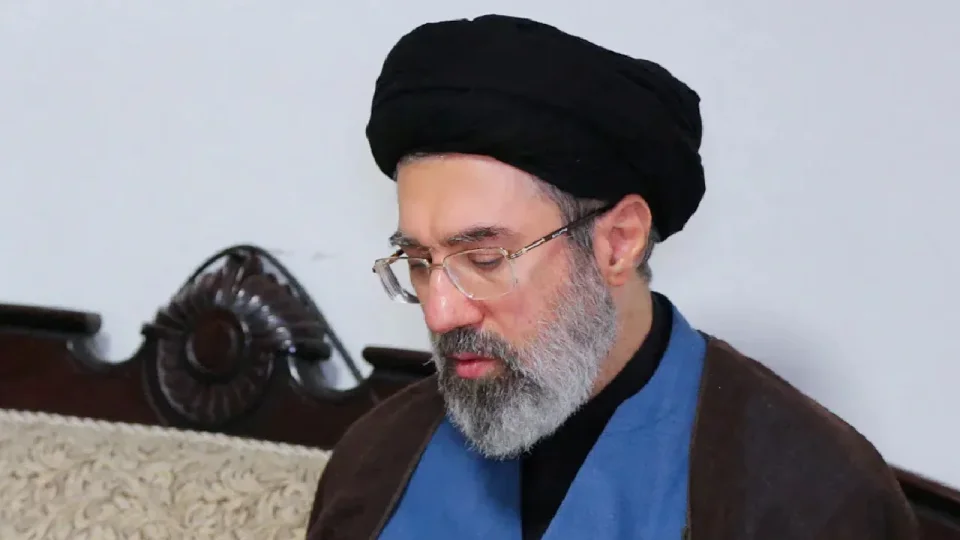
Courtesy: Irani State Media
Iran News: Iran’s Supreme Leader Mojtaba Khamenei used a written message on Sunday to tell rulers of Muslim states, especially those on the Persian Gulf, to identify what he called their real enemy and confront it. The text was released for Islamic Unity Week, which marks the birthday of the Prophet Muhammad. Xinhua, ANI and Iranian state media carried the same core lines.
He has held the post since shortly after his father, Ali Khamenei, was killed at the start of the Middle East war on 28 February, according to News9live and RTHK. Authorities have released no verified video or audio of him since the appointment. Sunday’s text was published on his Telegram account and official site. Ayatollah Qomi read it at an Islamic unity conference in Mashhad, APT reported.
“The solution to the problems of the Islamic nations is unity of words, friendship and cooperation on the path of goodness,” he said, according to his official website as quoted by RTHK. “Anyone, in any position, who does anything that leads to division among Muslims and creates conflict in the Muslim community, knowingly or unknowingly, intentionally or unintentionally, has served the purpose of the enemies of Islam.”
Who does Tehran want Gulf capitals to confront?
The target of the note is not left vague. “My strong and repeated advice to the rulers of Islamic countries, especially those in the West Asia region and the Persian Gulf, is to recognize your true enemies, understand their plan, and confront them,” Xinhua quoted him as saying.
“The criminal rulers of America and the fake Zionist regime are sworn enemies of this unity and friendship,” LBC quoted from the message. He said Washington and Israel were hostile not only to Iran and the “resistance” front but to the wider Muslim ummah in West Asia and North Africa, including rulers who are treated as US allies. He also asked whether Gulf states would have let “corrupt and identity-less scoundrels from thousands of kilometers away” covet their land if they had stood “under the banner of Islam.” He asked whether Palestinians would have been left “so helpless” if Muslims had stayed united.
That appeal lands on a strained map. During the war Iran struck US facilities in Saudi Arabia, the UAE, Jordan, Kuwait, Qatar and Bahrain. Ties with those hosts soured. Middle East Monitor, citing Anadolu, said Iran and the United States agreed a ceasefire in April and signed a June memorandum aimed at ending the fighting. Sunday’s language still treats the US and Israel as the organising threat.
On X the line about a “real enemy” circulated through news clips and commentary accounts within hours. That is amplification, not a Gulf government reply. No official response from Riyadh, Abu Dhabi or Doha was in the reports used for this article.
Why a written note, and why now?
Six months into the war, the new leader is still a text on a screen. The Friday message, issued for Government Week, told Iranians that harming social cohesion was “prohibited” and warned officials against “discouraging statements.” He rejected frames such as “war or negotiations” and “compromise or warmongering.” He also pushed domestic production and a gradual shift away from the dollar after a US naval blockade and older sanctions, News9live reported. Israel National News linked that Friday note to Washington’s “Operation Economic Outcast.”
Sunday’s Unity Week text extends the same argument outward. Division at home is forbidden. Division among Muslim governments is described as service to the enemy. Unity is called the base of an “Islamic civilisation.”
Whether Gulf rulers hear a religious festival greeting or a demand to break with Washington is a political choice those capitals have not publicly answered in the coverage so far. Iran’s strikes on bases in their territory remain the recent memory. The unseen supreme leader is asking them to treat that memory as secondary to a larger enmity.
The war calendar will decide how much weight the note carries. For now it is a written claim of leadership over a region that has spent 2026 absorbing Iranian missiles and American pressure at the same time.